
International Day of Zero Tolerance for Female Genital Mutilation
The domestication of the Violence Against Persons Prohibition (VAPP) Act across several Nigerian states, alongside intensified advocacy to end harmful practices such as Female Genital Mutilation (FGM), suggests that these practices will disappear for good. But is that really the case?
Across Nigeria, FGM is largely driven by social rules or cultural beliefs, enforced by families and communities. Despite laws banning FGM and widespread evidence of its harmful effects on physical, sexual, mental, maternal, and child health, the practice persists because community expectations often outweigh legal consequences. Families act out of fear of judgement, dishonour, and exclusion.
The beliefs that sustain FGM vary across communities. In some areas, it is seen as necessary for spiritual cleanliness. In others, it is believed to prevent complications during childbirth or curb promiscuity. For some families, social respect, marriageability, and even inheritance rights are tied to whether a girl has been cut. To grow up “properly”, girls are expected to conform. Those who resist risk exclusion, shame, and, in some cases, violence.
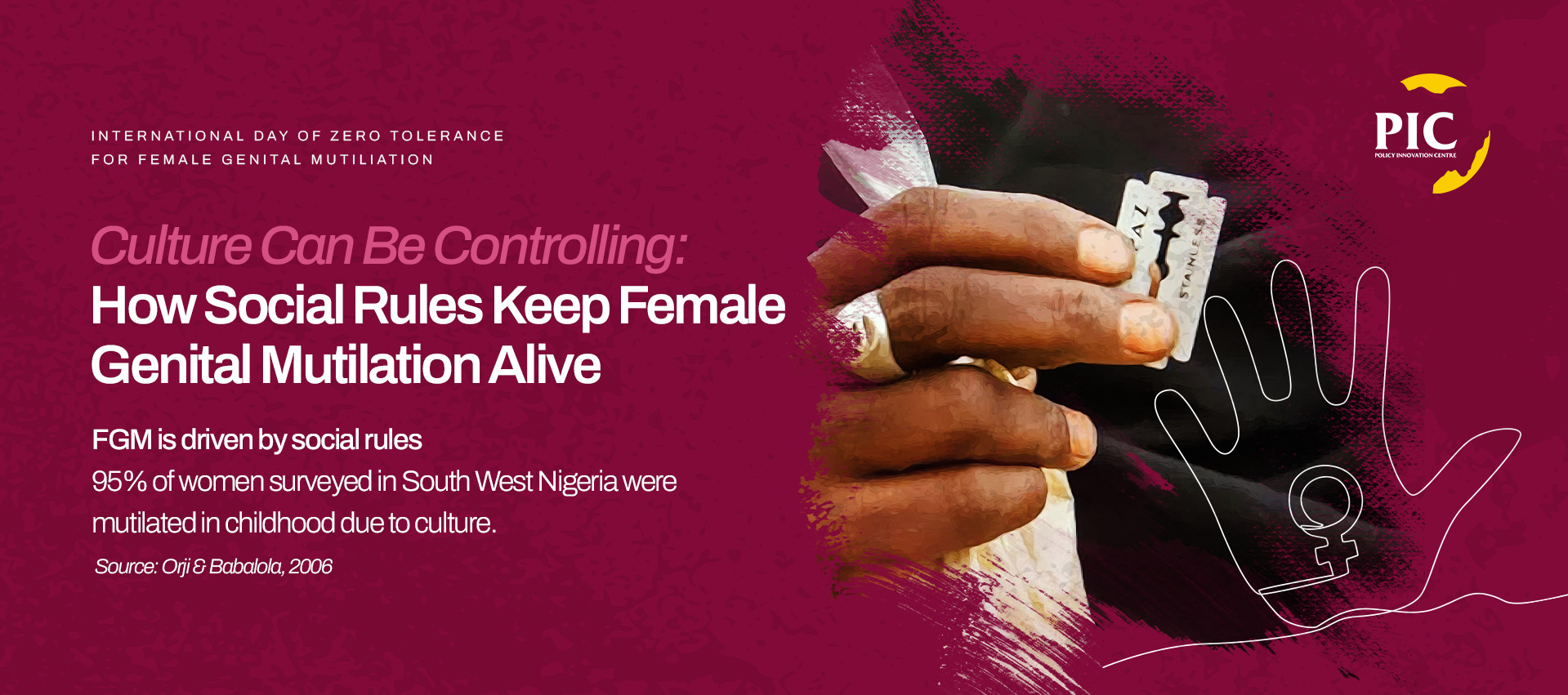
Evidence confirms how powerful these norms are. A survey of 500 women in Southwest Nigeria found that 85% had undergone FGM, most of them in childhood. Nearly all (95%) cited culture as the main reason. About 49% mentioned preventing promiscuity, while others pointed to family pressure or the belief that the practice protects newborns. These are not just numbers; they reveal the depth of control that culture and social rules exert over individual choices. So strong is this control that the pain and trauma inflicted on children are not enough reasons for parents to protect their children from the practice. Instead, it is often brushed off with phrases like, “That’s our tradition” or “This is how it has always been done.” And it’s within this system that older women, many of whom were cut themselves, take on the role of keeping the tradition alive, enforcing it to protect family honour and preserve cultural identity, and ensuring it is passed down from one generation to the next.
The grip of these social rules or norms comes at a devastating cost. Beyond controlling choices and enforcing conformity, FGM exposes girls and women to immediate risks such as severe pain, bleeding, infection, trauma to the urogenital system, and, in extreme cases, death. Long-term complications include difficult or prolonged labour, perineal tears, postpartum haemorrhage, stillbirth, urinary and reproductive tract complications, sexual dysfunction, and psychological harm, including depression, anxiety, and post-traumatic stress disorder.
As we mark the International Day of Zero Tolerance for Female Genital Mutilation, under the theme “Towards 2030: No End to FGM Without Sustained Commitment and Investment”, we must confront a hard truth. Ending FGM is not only about legislation or awareness, though; both are essential. It is about finding the courage to challenge the social rules or norms that govern girls’ lives, holding on to that courage, and sustaining the fight over time so that change is real and lasting. We must ask ourselves uncomfortable questions: Why are we still mutilating our daughters in the name of culture? Why does conforming to social rules come at the cost of a girl’s body, health, and dignity?
The impact of social norms doesn’t end with FGM. These same social rules shape adolescent health and wellbeing more broadly, influencing how young people understand their bodies, exercise agency, seek care, and navigate sexuality, education, and safety. In the light of this, the Policy Innovation Centre is conducting research to examine how social norms affect adolescent health outcomes in Nigeria, with the goal of generating evidence to inform stronger, norm-responsive policies and interventions. Findings from this work will be shared in the coming months.
References
Orji, E., & Babalola, A. (2006). Correlates of Female Genital Mutilation and Its Impact on Safe Motherhood. J Turkish-German Gynecol Assoc, 7, 319–324.
UNFPA. (2021). Female genital mutilation in Nigeria: Situation analysis. United Nations Population Fund.