

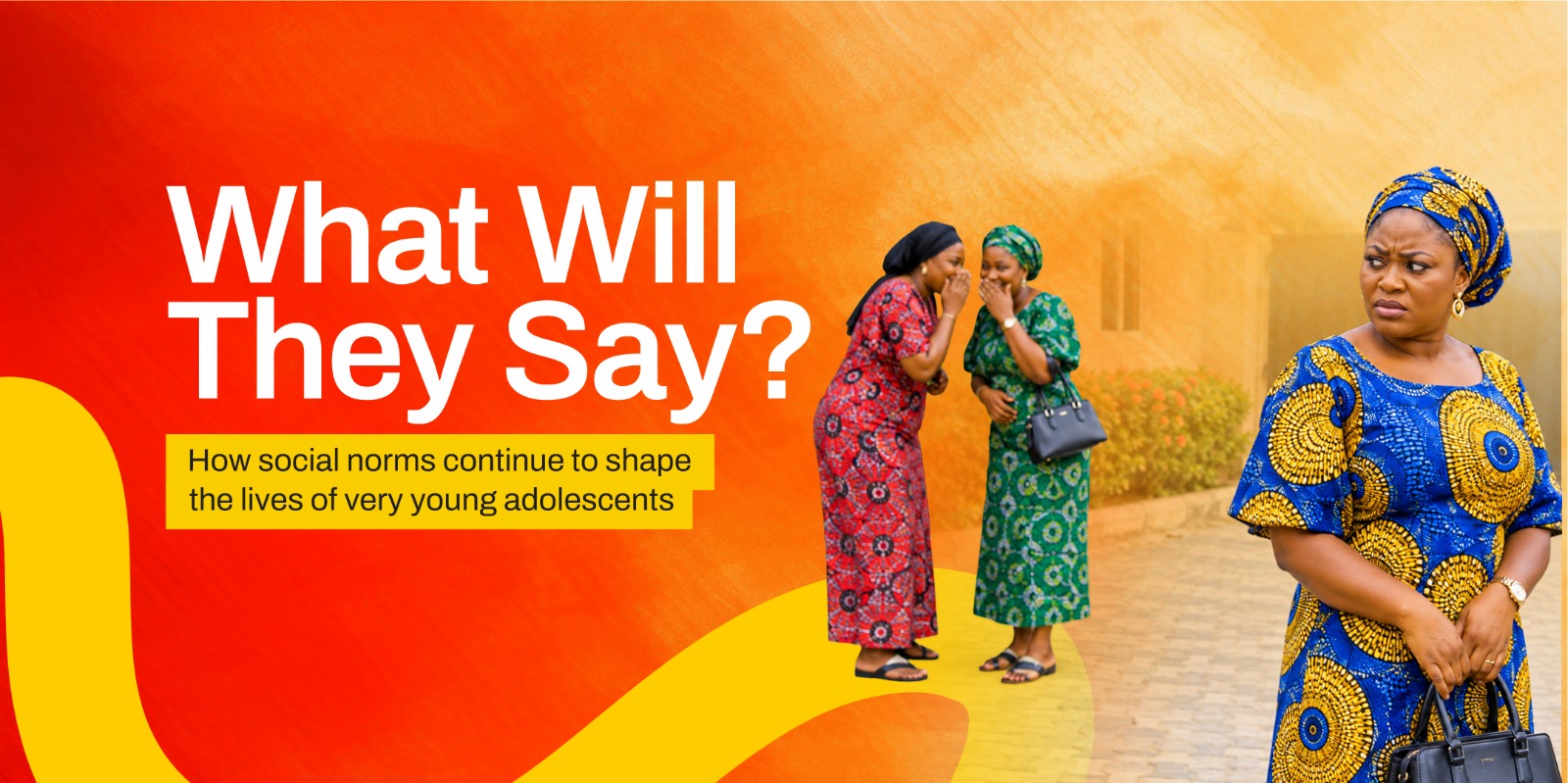
How social norms continue to shape the lives of very young adolescents
When Glady's uncle, who lives in a remote town in Benue state, makes a decision that changes his niece’s life forever, putting a hold to her education, marrying her early, it’s easy to assume poverty alone made that decision inevitable. But what we found in our study, from engaging with parents, teachers, health workers, Civil Society Organisations (CSOs), and community leaders across 12 Nigerian states, tells us more about the power of shared beliefs.
These shared beliefs, often called social norms, can sound abstract until you see how they work in real life. They are the quiet rules that signal what is okay, what is not, and what will attract judgement. They are enforced not by law or policy, but by people through gossip, advice from elders, religious interpretation, and the constant awareness of “what will people say?” And once you start looking, you see them everywhere.
Take early marriage as an example. Despite a national law that sets the minimum age of marriage at 18, in Nigeria are still being married much younger in many communities. During our study, what we repeatedly heard is that when a household is under financial strain, especially in settings of displacement, insecurity, or extreme poverty, marriage is seen as a way to reduce household burden or secure material support for a girl. In those circumstances, early marriage functions as a survival mechanism.
However, more perspectives that also emerged is that early marriage is often the response when a girl becomes pregnant, as it restores dignity, protects the family’s reputation and quiets gossip. It fits what elders and, in some cases, religious framings reinforce as the “right” response. In that moment, families are not weighing laws or long‑term outcomes. They are responding to the social environment around them..
This is where poverty is often misunderstood. Poverty does not create the belief that marriage restores honour, or that silence preserves respect. Those beliefs already exist. What poverty does is make it harder to resist them.
This also helps explain why awareness alone is not enough. Ejiro's Uncle may understand the risks of early marriage, but knowledge does not erase stigma. Information does not protect him from the cost of choosing differently. What our study makes clear is that decisions are not made by individuals who are acting alone. They are made within networks of parents, peers, religious leaders, traditional authorities, and neighbours that collectively sustain norms or these shared beliefs. As long as those shared beliefs remain intact, change will remain slow, no matter how much information or awareness is available.
None of this means poverty doesn’t matter. It does. But reducing economic pressure without addressing shared beliefs leaves the strongest constraint untouched. Because real change happens when options exist and choosing differently no longer feels dangerous.
To understand how shared beliefs or social norms shape adolescent wellbeing across issues like child marriage, Gender Based Violence (GBV), Sexual Reproductive Health (SRH), Human Papillo Virus (HPV) vaccination, and girls’ economic opportunities, and how these patterns differ by state, read the full study here.
The Very Young Adolescents Survey (VYAS), led by the Policy Innovation Centre and supported by the Gates Foundation, seeks to examine not only gender norms that reinforce child marriage but also the interconnected issues including gender-based violence, sexual and reproductive health, HPV vaccination, and women’s economic empowerment that shape health and wellbeing of adolescents aged 10 to 14 in Nigeria.